William Howard Taft: The 27th President, 1909-1913 by Jeffrey Rosen
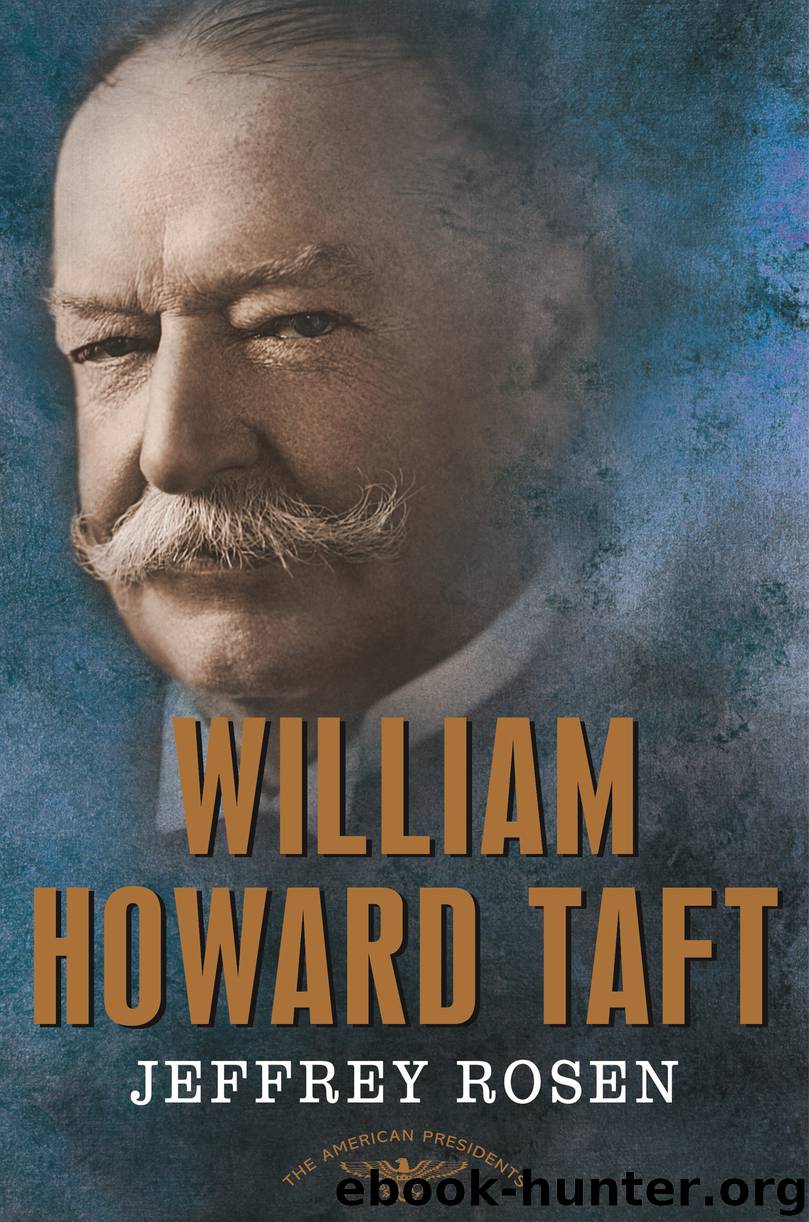
Author:Jeffrey Rosen
Language: eng
Format: epub
Publisher: Henry Holt and Co.
5
“Popular Unrest”: The Election of 1912 and the Battle for the Constitution
On February 21, 1912, after delivering a speech called “A Charter for Democracy” at the Ohio Constitutional Convention in Columbus, Theodore Roosevelt made the decision to challenge William Howard Taft for the Republican nomination for president. The speech, a radical attack on judicial independence and on constitutional checks on the passions of the people, defined the election in Taft’s mind as a crusade to defend the Constitution and the rule of law against the pure democracy threatened by Roosevelt, who was increasingly sounding like a demagogue.
“I believe in pure democracy,” Roosevelt began. “It is a prime duty of the people to free our government from the control of money in politics,” he continued, and “unless representative government does absolutely represent the people it is not representative government at all.” As a result, he demanded, “as weapons in the hands of the people, all governmental devices which will make the representatives of the people more easily and certainly responsible to the people’s will.” Roosevelt endorsed a series of populist reforms, including elected state judiciaries, presidential primaries based on “direct nominations by the people,” and direct election of U.S. senators, adding, “I believe in the initiative and the referendum, which should be used not to destroy representative government, but to correct it when ever it becomes misrepresentative.”1
What most alarmed Taft and other constitutionalists was Roosevelt’s attack on judicial independence. He assailed Supreme Court justice William Moody by name for ruling against “a railway man named Howard, I think.” The former president sounded most radical when he endorsed the right of the people to overturn state court decisions they thought incorrect or to recall state judges with whom they disagreed. “When a judge decides a constitutional question, when he decides what the people as a whole can or cannot do, the people should have the right to recall that decision if they think it wrong,” Roosevelt declared.2
In the Cleveland train station, on the way back from Columbus, Roosevelt announced his candidacy for president. “My hat is in the ring,” he said. “The fight is on and I am stripped to the buff.” Days later, he distributed a letter from eleven Republican governors asking him to challenge Taft, along with his reply: “I will accept the nomination for President if it is tendered to me, and I will adhere to this decision until the convention has expressed its preference.”3 That evening, before a White House dinner, Taft was handed an Associated Press report on Roosevelt’s statement, which he read and passed along to his guests.
“I told you so four years ago, and you would not believe me,” Nellie exclaimed, breaking the silence.
“I know you did, my dear, and I think you are perfectly happy now,” Taft replied. “You would have preferred the Colonel to come out against me than to have been wrong yourself.”4
Although Taft believed that Roosevelt would beat him at the Republican Convention in June, he was roused to fight on
Download
This site does not store any files on its server. We only index and link to content provided by other sites. Please contact the content providers to delete copyright contents if any and email us, we'll remove relevant links or contents immediately.
Waking Up in Heaven: A True Story of Brokenness, Heaven, and Life Again by McVea Crystal & Tresniowski Alex(37813)
Empire of the Sikhs by Patwant Singh(23089)
We're Going to Need More Wine by Gabrielle Union(19051)
Hans Sturm: A Soldier's Odyssey on the Eastern Front by Gordon Williamson(18594)
Leonardo da Vinci by Walter Isaacson(13339)
The Radium Girls by Kate Moore(12033)
Tools of Titans by Timothy Ferriss(8402)
Educated by Tara Westover(8056)
How to Be a Bawse: A Guide to Conquering Life by Lilly Singh(7490)
Permanent Record by Edward Snowden(5850)
The Last Black Unicorn by Tiffany Haddish(5640)
The Rise and Fall of Senator Joe McCarthy by James Cross Giblin(5282)
Promise Me, Dad by Joe Biden(5155)
The Wind in My Hair by Masih Alinejad(5100)
A Higher Loyalty: Truth, Lies, and Leadership by James Comey(4965)
The Crown by Robert Lacey(4818)
The Iron Duke by The Iron Duke(4365)
Joan of Arc by Mary Gordon(4116)
Stalin by Stephen Kotkin(3971)
